Footprints traces the history and movement of Jewish books since the inception of print.
The history of the book is an important part of humanities scholarship. Especially as more books are digitized, scholars, librarians, collectors, and others have become increasingly attuned to the significance of individual books as objects with their own unique story. Jewish books in particular tell a fascinating story about the spread of knowledge and faith in a global Diaspora.
Every literary work represents a moment in time and space where an idea was conceived and documented. But the history of a book continues long after composition as it is bought, sold, shared, read, confiscated, stored, or even discarded. This history is the essence of Footprints.
Digiberichte.de aims to advance research on late medieval and early modern European travel accounts. This project provides digitized editions and research literature on approx. 375 different travels and pilgrimages through Europe in historical times. The bibliographical database allows quick reference for the travel accounts. Due to copy right restrictions only literature from the 19th century and earlier is provided in full text.
The majority of the material provided here is based on the so called “analytical bibliographies” of medieval travel accounts that have been edited under the direction of Prof. Werner Paravicini and published by Peter Lang. Initially only bibliographies on German, French and Dutch travel-accounts have been published, but there was always the idea of collecting material for the other European countries (especially Italy, England, Spain, Portugal, Scandinavia and East-Europe) as well. Digiberichte.de therefore collects information also for travelers from these countries that left accounts of their journey.
2017 is the 500th anniversary of an event that is widely regarded as having precipitated the Protestant Reformation: the posting of Martin Luther’s 95 theses on a church door in the small German town of Wittenberg on 31 October 1517. In the intervening centuries, this episode has become deeply embedded in myth and legend. Although scholars now doubt whether it occurred in precisely this form, its anniversary is serving to stimulate fresh discussion and debate about the momentous schism within Christendom that took place in its wake, and its long term repercussions and effects.
This exhibition is one of the principal fruits of ‘Remembering the Reformation’, an interdisciplinary and collaborative research project generously funded by the UK Arts and Humanities Research Council (http://rememberingthereformation.org.uk/). Bringing together historians (Alex Walsham and Ceri Law, University of Cambridge) and literary scholars (Brian Cummings and Bronwyn Wallace, University of York), it investigates how Europe’s multiple and competing Reformations were remembered, forgotten, contested, and re-invented. It explores how the memories of these movements were created and emerged in the sixteenth and seventeenth centuries, as well as the complex, plural, and enduring legacies such memories have left.
Prefaced by a general section on Memory, the exhibition is divided into twelve categories that reflect the four themes around which the ‘Remembering the Reformation’ project is organised: (1) Lives and Afterlives ; (2) Events and Temporalities; (3) Objects, Places, and Spaces; and (4) Ritual, Liturgy, and the Body. A joint enterprise involving Cambridge University Library, Lambeth Palace Library and York Minster Library, the exhibition displays some of the many treasures in their rich manuscript, rare book, and artefact collections, as well as items from several other repositories in Cambridge and beyond.
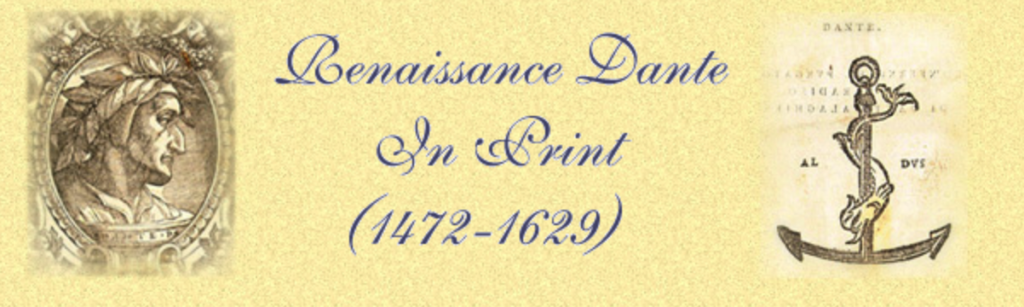
THIS EXHIBITION presents Renaissance editions of Dante’sDivine Comedy from the John A. Zahm, C.S.C., Dante Collection at the University of Notre Dame, together with selected treasures from The Newberry Library. The Zahm collection ranks among the top Dante collections in North America. Purchased for the most part by Zahm in 1902 from the Italian Dantophile Giulio Acquaticci, the 15th- and 16th- century imprints presented here form the heart of Zahm’s collection, which totals nearly 3,000 volumes, including rare editions and critical studies from the Renaissance to the present. The nine incunable editions and nearly complete series of 16th-century imprints featured in this exhibit constitute essential primary sources for both the history of Dante’s reception during the Renaissance and the early history of the printed book.
The concentrated Dante collection at Notre Dame is nicely complemented by the wide-ranging holdings of The Newberry Library in Renaissance literature and history, and especially for the history of printing and publishing. These two rich and varied collections have often been used by Dantists in the Midwest and from abroad. The complementarity of the collections is mirrored in the formal cooperation of Notre Dame and The Newberry Library through the consortium of The Newberry Library Center for Renaissance Studies, of which Notre Dame has been an active member since 1983. The exhibit was originally held at the Department of Special Collections, University Libraries, University of Notre Dame, October 15 – December 15, 1993 and the Newberry Library between 15 April – 15 June, 1994, and has been produced in expanded form for Internet publication by a collaboration between the William and Katherine Devers Program in Dante Studies, University of Notre Dame and the ARTFL Project of the University of Chicago. The Devers Program, the ARTFL Project, and the Newberry Library are proud to welcome you to Renaissance Dante in Print (1472-1629).
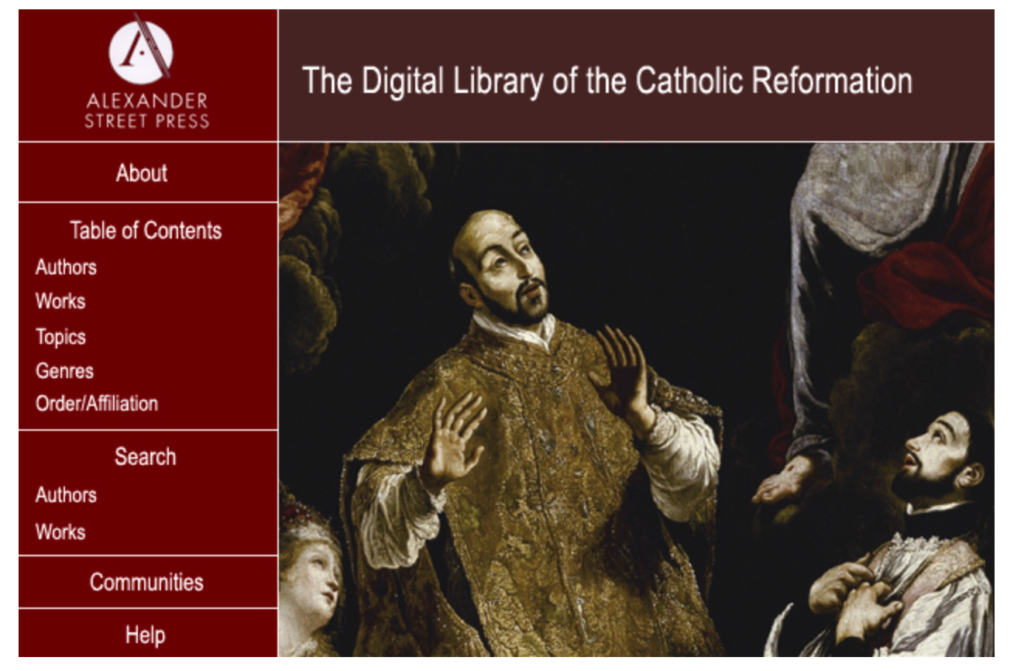
A uniquely valuable resource for historians, theologians, political scientists, and sociologists studying the religious and social upheavals of the 16th and 17th centuries, the Digital Library of the Catholic Reformation gives researchers immediate, Web-based access to an extensive range of seminal works from the Reformation and post-Reformation eras.
With 845 titles by 277 authors, the collection is a treasury of theological writings, biblical commentaries, confessional documents, social and political works, sermons, letters, polemical treatises, and other key documents from this critical epoch in European history.
Digital Dante offers original research and ideas on Dante: on his thought and work and on various aspects of his reception. Though our editorial structure is that of an academic journal, we do not publish prose essays, instead showcasing work that intersperses prose with visual components (see Author Guidelines). We accept contributions from scholars and Dante lovers around the world.
We feature original scholarship on Dante in three different contexts:
1) TheCommento Baroliniano is the first online commentary to the Divine Comedy. The Commento is an original work written expressly for Digital Dante and it distills a lifetime of scholarship.
2) Intertextual Dante is a vehicle for intertextual study of the Divine Comedy developed by Julie Van Peteghem and featuring her original scholarship on Dante and Ovid.
3) Image, Sound, History and Text are the categories through which we present original pieces contributed by artists, philosophers, and scholars from around the world.
This resource contains information on the conditions and literary traditions of early modern Spain, including primary-source documents from the Newberry Library collection.
This resource examines similarities between 17th-century England and classical Rome, including primary-source documents from the Newberry Library collection.
Digital Collections for the Classroom: Marriage and Family in Shakespeare’s England
Source documents and background information showing the ways in which Shakespeare’s plays respond to changes in the understanding and organization of family during the English Renaissance.