Records of the Parliaments of Scotland to 1707
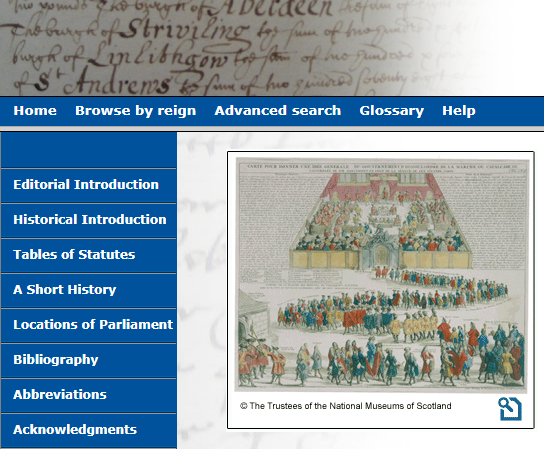
A fully searchable database containing the proceedings of the Scottish parliament from the first surviving act of 1235 to the union of 1707.
Records of the Parliaments of Scotland to 1707
A fully searchable database containing the proceedings of the Scottish parliament from the first surviving act of 1235 to the union of 1707.
Digital Collections for the Classroom: Aphra Behn’s Oroonoko: Slavery and Race in the Atlantic World
Classroom-ready, primary-source documents relating to Aphra Behn’s 1688 novel Oroonoko and the Atlantic slave trade from the Newberry Library collection.
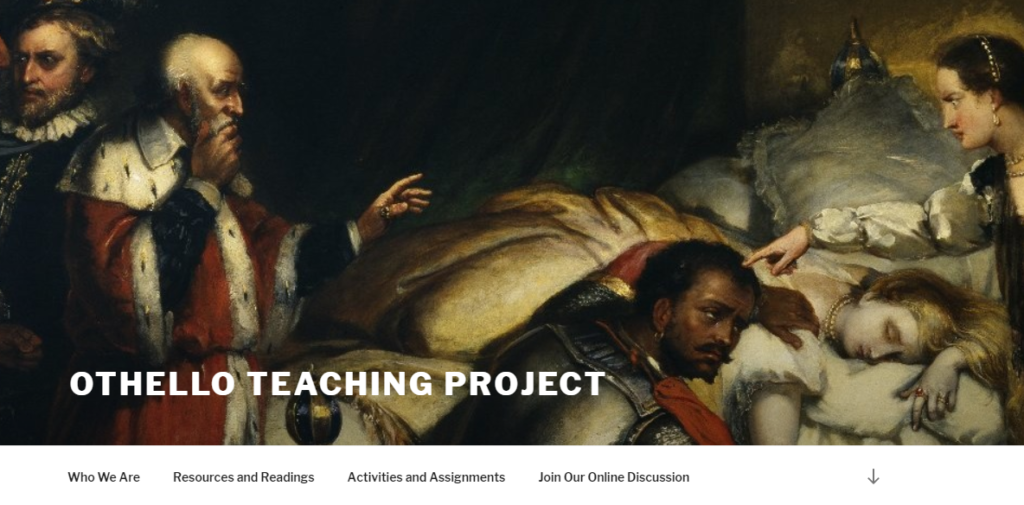
This is a collaborative online resource for teaching Othello, including readings, activities and assignments, self-grading quizzes, discussion forum, and links for sharing assignments with classmates and faculty around the world. The goal is to link professors and students from very different areas of our too-divided world, and also very different kinds of selective and open admissions institutions in conversation about race, difference, migration, sex, gender, domestic violence, and Othello.
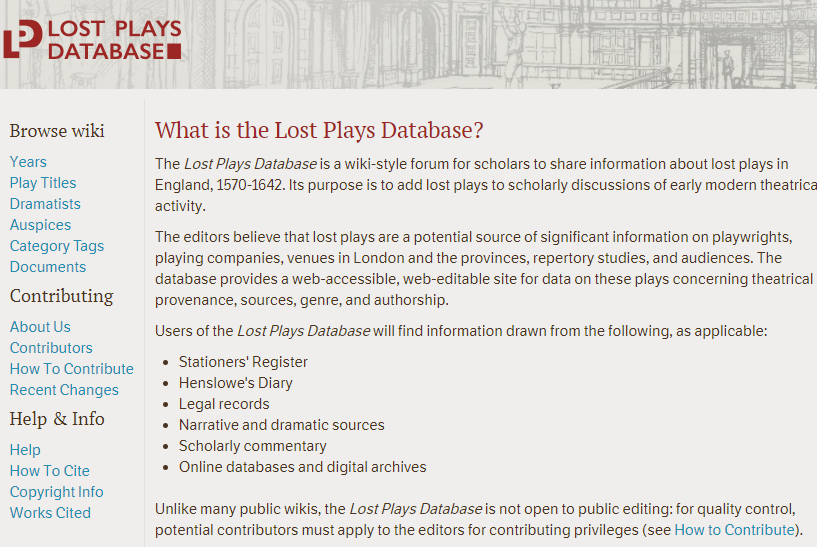
The Lost Plays Database is a wiki-style forum for scholars to share information about lost plays in England, 1570-1642. Its purpose is to add lost plays to scholarly discussions of early modern theatrical activity.
Lexicons of Early Modern English
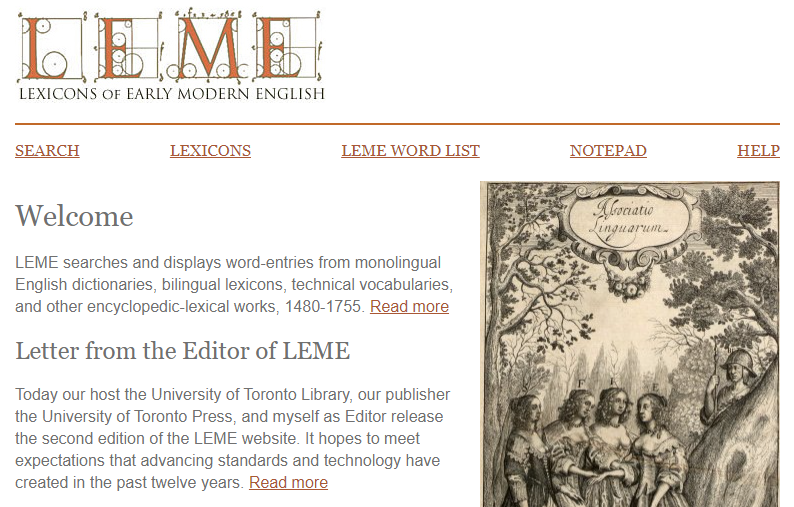
A database of 186 lexical texts published or written in England from 1475 to 1702 that hold fully searchable 620,000 word-entries. LEME offers unique digitized access to dictionaries, glossaries, and other lexical texts in a host of languages, focusing on English but including major works in Latin, French, Italian, and Spanish. LEME is hosted by the University of Toronto Library and published (since 2006) by the University of Toronto Press. It grows annually.
Early Americas Digital Archive
EADA is a collection of electronic texts and links to texts originally written in or about the Americas from 1492 to approximately 1820.
Early Modern Female Book Ownership
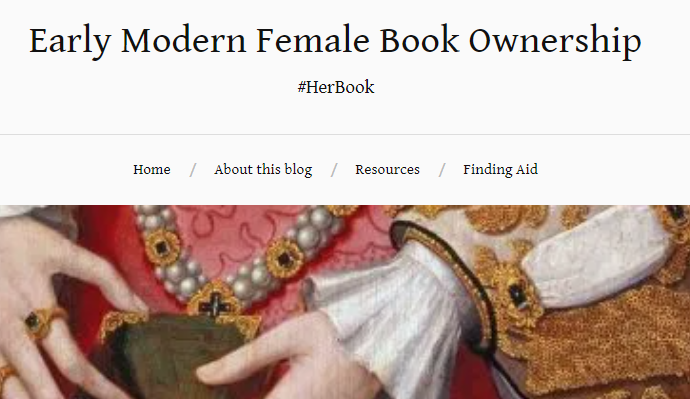
A collection of important evidence for research on early modern women, this blog features posts with evidence of early modern female book ownership, including signatures and other marginalia.
https://www.graphikportal.org
The Graphikportal – Europe’s first union online catalogue especially designed for drawings and prints. The art historical database developed at the German Documentation Centre for Art History – Bildarchiv Foto Marburg, provides a large online pool of works of art of the European cultural heritage. At the start, around 300,000 works of art from 24 European collections are online, including the prints and drawings departments of the Staatliche Museen zu Berlin – Preußischer Kulturbesitz, the Staatliche Kunstsammlungen Dresden and the Hamburger Kunsthalle. The Albertina and the MAK Bibliothek und Kunstblättersammlung in Vienna, the Graphische Sammlung of the ETH Zurich and the Zentralbibliothek Zürich or the Bibliotheca Hertziana – Max Planck Institute for the History of Art in Rome are also present. Last but not least, the collections of the Virtuelles Kupferstichkabinett, a cooperation between the Herzog Anton Ulrich Museum and the Herzog August Bibliothek Wolfenbüttel, will be integrated as well. For the first time across collections the new Graphikportal makes these hidden treasures of the European cultural heritage accessible to a wider public on the Internet. All these institutions are members of the international working group «Graphik vernetzt» (Graphics networked), which aims to agree on common digitization standards and designing strategies for the further digital networking of graphic collections. This digital networking offers a real scientific added value, which can be used for the first time in the graphics portal on this scale. For example, all proofs deriving from the same plate or block are brought together in one search result.
An annotated, parallel-text edition of Holinshed’s Chronicles of England, Scotland, and Ireland, which was at once the crowning achievement of Tudor historiography and the most important single source for contemporary playwrights and poets, above all Shakespeare, Spenser, Daniel, and Drayton.
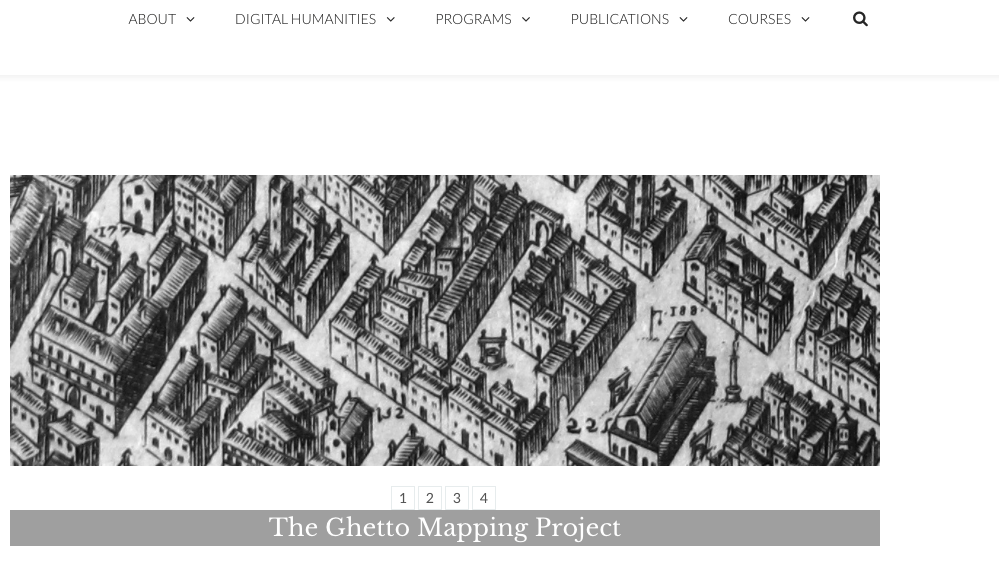
The Jewish History Program has recently launched the Ghetto Mapping Project, a research project whose aim is to reconstruct the economic and social fabric of the Florentine ghetto, the third oldest ghetto in the world. Grand Duke Cosimo I established the ghetto of Florence in 1570, near the area of Mercato Vecchio, in the very center of the Tuscan capital. While officially erected to gather all the Jews of the Grand Duchy under the aegis of Counter-Reformational tenets, the ghetto of Florence was in fact a product of a very well planned, private real-estate investment of the Medici family.
The Ghetto Mapping Project consists of three main parts:
1. The virtual reconstruction of all the spaces in ghetto, from its foundation in 1570 to its demolition in 1888. This will be executed by elaborating and combining together into a 3D model, architectural information gleaned from detailed and comparative surveys of the ghetto drafted for the Medici. In addition to this data, this project will also incorporate archival documents, paintings, watercolors, and archaeological surveys from other Florentine collections. The ghetto is probably the most documented neighborhood of Florence. As such, this study will provide invaluable information to scholars working on any field related to the humanities. Moreover, as one of the first examples of a planned, semi-public housing project in modern Europe, this digital initiative will also be of primary importance to architects, urban planners, and sociologists.
2. Ghetto economy. The ghetto was a Medici property. Therefore, the entire complex, its inhabitants, and anything housed within its premises was carefully described and recorded by Medici functionaries. From an archival and documentary standpoint, the ghetto was one of the most heavily controlled areas of the city. Despite the incredible wealth of available archival sources, the ghetto has ever been studied with specific economic-financial perspective. Medici administration produced, over a period of circa two centuries, hundreds of volumes pertaining to the ghetto, which provide us with an unprecedented quantity of economic and financial information.
3. Demography and history. Along with architectural and economic information, Medici documents offer one of the richest, most exhaustive, and chronologically most extended set of Jewish demographic data. This corpus of archival material will allow us not only to determine precisely how many Jews lived in the ghetto in any specific period of its history, but also to trace family ties and outline genealogical trees.