All Resources

Digital Codex Mendoza

Digital Codex Mendoza

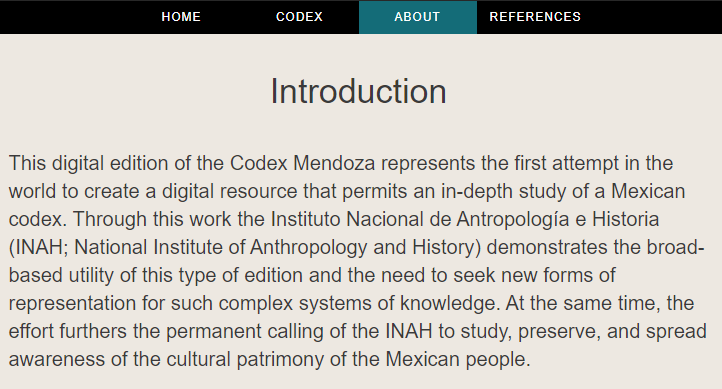
The Codex Mendoza was created under the orders of Viceroy Antonio de Mendoza to evoke an economic, political, and social panorama of the recently conquered lands. It was made in 1542 and since 1659 it has been in the collection of the Bodleian Library. This digital edition of the Codex Mendoza represents the first attempt to create a digital resource that permits in-depth study of a Mexican codex.

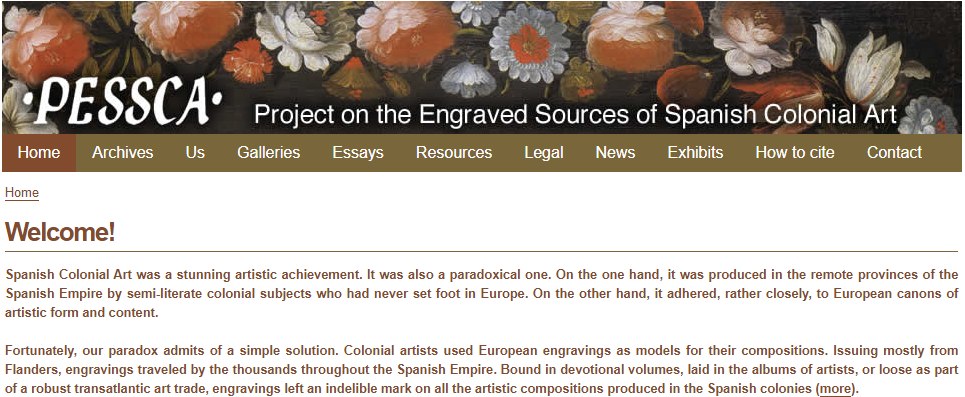
Project on the Engraved Sources of Spanish Colonial Art (PESSCA)

Project on the Engraved Sources of Spanish Colonial Art (PESSCA)

The goal of the Project on the Engraved Sources of Spanish Colonial Art (PESSCA) is to document the effect of European prints on Spanish Colonial Art. To reach its goal, PESSCA has been pairing colonial works of art with their engraved prototypes and posting them online. As of now, PESSCA has gathered more than 5000 such pairings.

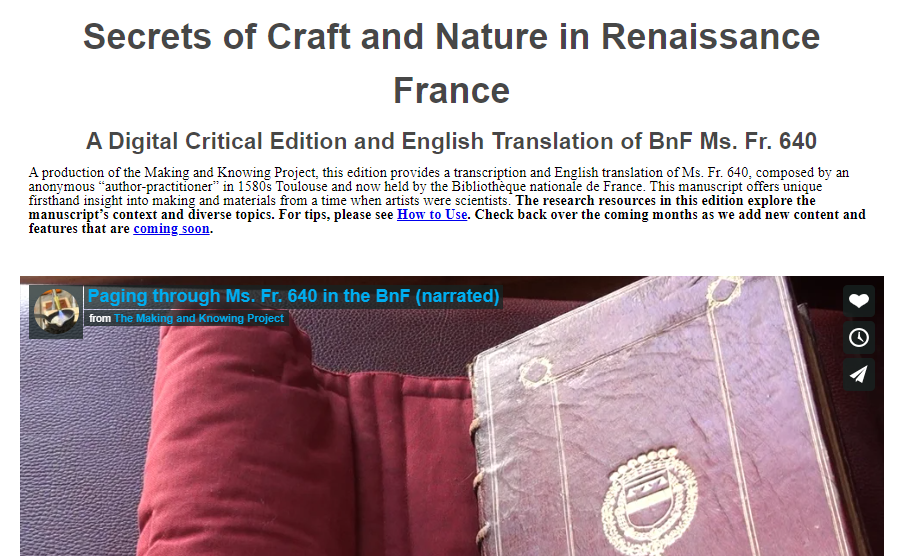
Secrets of Craft and Nature in Renaissance France. A Digital Critical Edition and English Translation of BnF Ms. Fr. 640

Secrets of Craft and Nature in Renaissance France. A Digital Critical Edition and English Translation of BnF Ms. Fr. 640

A production of the Making and Knowing Project, this edition provides a transcription and English translation of Ms. Fr. 640, composed by an anonymous “author-practitioner” in 1580s Toulouse and now held by the Bibliothèque nationale de France. This manuscript offers unique firsthand insight into making and materials from a time when artists were scientists. The research resources in this edition explore the manuscript’s context and diverse topics.

Biblioteca Virtual del Patrimonio Bibliográfico

https://bvpb.mcu.es/es/inicio/inicio.do

La Biblioteca Virtual del Patrimonio Bibliográfico, gestionada por la Subdirección General de Coordinación Bibliotecaria del Ministerio de Educación, Cultura y Deporte, es una biblioteca digital en la que se ofrece a los ciudadanos una valiosa y creciente colección de reproducciones facsímiles digitales de manuscritos, libros impresos, fotografías históricas, materiales cartográficos, partituras y demás materiales que se conservan en instituciones de la memoria (archivos, biblioteca y museos) y forman parte del Patrimonio Bibliográfico Español. Esta iniciativa permite a los ciudadanos consultar sin restricciones fondos, en su mayoría públicos que, por sus características, se conservan en depósitos especiales y son difícilmente accesibles. El proyecto es el fruto de la cooperación del Ministerio de Educación, Cultura y Deporte y las Comunidades con las comunidades autónomas y otras administraciones e instituciones públicas o privadas. Los fondos digitalizados provienen de bibliotecas, archivos y museos, de comunidades autónomas, ministerios, ayuntamientos, ateneos, fundaciones, universidades, instituciones privadas, reales academias, particulares, etc. Gracias al trabajo y colaboración de todas estas personas e instituciones, que realizan tareas de selección de fondos y los ceden para su digitalización ha sido posible sacar adelante este proyecto.
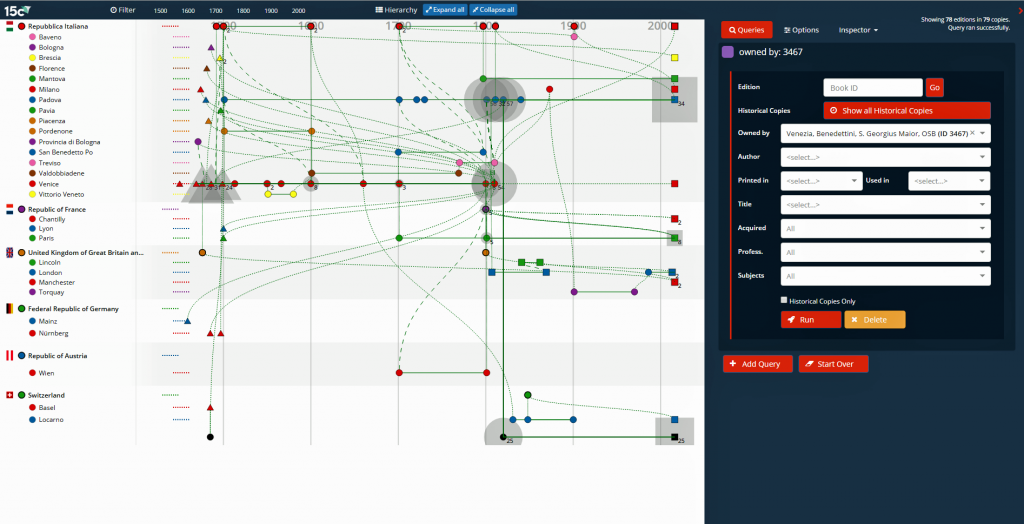
15cBookTrade Project

Home

Books printed between 1450 (the year of Gutenberg’s invention of modern printing) and 1500 (conventional cut-off date in scholarship) are known as incunabula. Some 30,000 editions are known today, in some 450,000 surviving copies, located in about 4,000 different public libraries, mostly in Europe and North America. Each surviving copy has a different history, which can be reconstructed with the help of physical evidence (ownership inscriptions, decoration, binding, coats of arms, manuscript annotations, stamps, prices, etc.) and bibliographical evidence (historic library catalogues, bookseller and auction catalogues, acquisition registers, etc.): all this is known as copy-specific information, or provenance, or material evidence, or post-production evidence. The idea that underpins the 15cBOOKTRADE Project is to use material and documentary evidence to address several fundamental questions relating to the introduction of printing in the West which have so far eluded scholarship, partly because of lack of evidence, partly because of the lack of effective tools to deal with existing evidence.

Private Libraries in Renaissance England

Private Libraries in Renaissance England

A companion to the published volumes of Private Libraries in Renaissance England, this searchable database is composed of book lists and library catalogs of private book collections in England collected from wills, inventories, and account ledgers.The aim of the collection is to reconstruct the history of book reading and collecting as well as the book trade.

Letturatura artistica

Letturatura artistica

‘Letteratura artistica’ (Art Literature) is a private, non-profit blog publishing reviews of books and investigations on art history sources. All the articles are available both in English and in Italian (the author is based in Bologna, Italy and possesses a specialized library of more than 2000 volumes on the topic). The blog presents more than 400 articles covering the Middle Ages to contemporary art. A special focus is dedicated to Cennino Cennini’s Libro dell’Arte and Giorgio Vasari’s Vite (1550 and 1568 editions). Renaissance treatises are discussed, not only in Italian, but in Dutch, English, French and Spanish. An index of all the published articles is available here.