Glasgow University Emblem Website
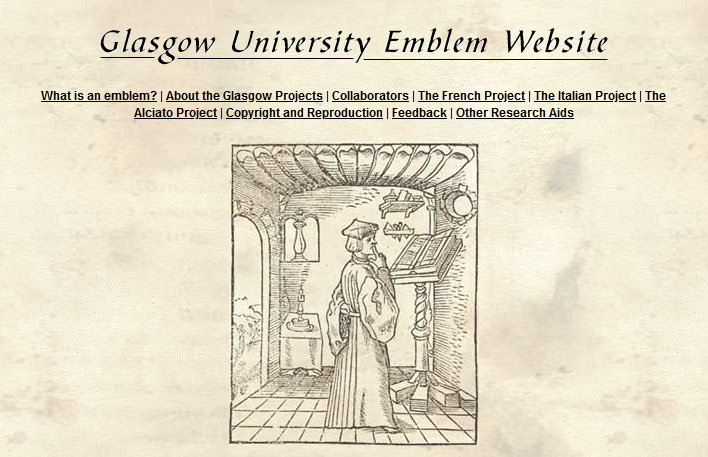
The primary online resource for Alciato and for French emblems.
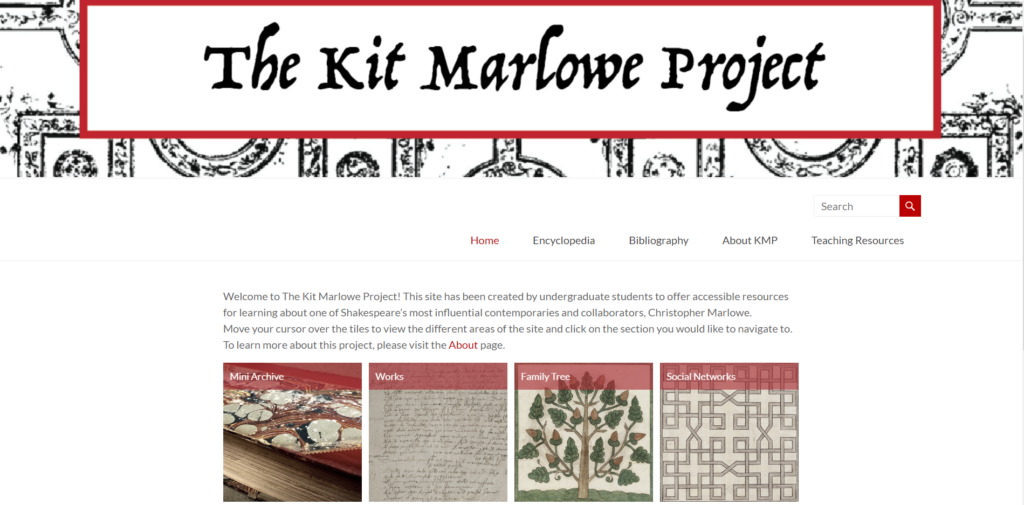
The Kit Marlowe Project is a digital space designed to introduce undergraduates with diverse majors to project-driven, research-based learning, and digital humanities practices in the context of studying one of Elizabethan England’s most compelling literary figures. As one of Shakespeare’s most famous contemporaries, Christopher Marlowe was a poet, playwright, and likely spy; his friends called him “Kit” and so do we. The site has been created so that students may curate an open-source collection of Marlowe’s works, contribute exhibits, encyclopedia, and bibliography entries, plus contribute to cultural preservation efforts by transcribing, encoding, and publishing archival works in an open-access forum. Excepting the About blogs, the Teaching Resources, the Contributor Resources, and the Mini-Archive documentation, all content has been student-generated.
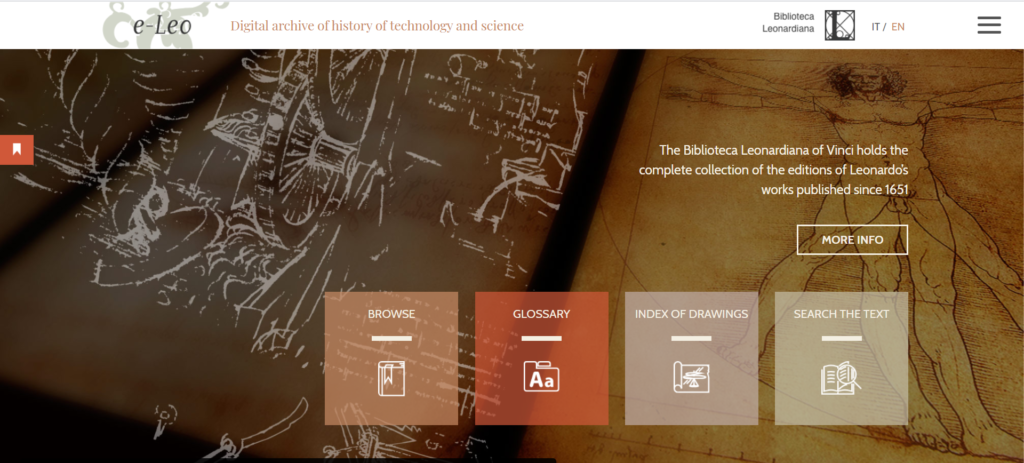
The e-leo experiment stems from the very particular nature of the Biblioteca Leonardina collection, which possesses the entire published corpus of Leonardo da Vinci’s works, starting with the first edition of the Treatise on Painting of 1651, and ranging from the oldest editions to the most recent facsimile publications, including those of the national edition of Leonardo’s manuscripts and drawings. The archive contains almost the entire corpus of Leonardo’s work, relying on its collection of editions (from the first, dated 1651), and has set itself an even more ambitious goal, that of contextualizing them within the broader framework of Italian and European historical and scientific heritage. The data in the archive are texts and drawings, analysed and classified by means of indexing methods for drawing searches, semantic glossaries, and search filter tools: an apparatus proposing an integrated processing model for Renaissance manuscripts by artist-engineers. In parallel, a scientific programme is being developed for the study of Leonardo’s specialized “languages” (mechanics, optics, anatomy, architecture, etc.), with the aim of giving access to the various 15th and 16th century manuscript production in the Vulgar Italian. A programme of translations into English of Leonardo’s corpus has also been started. Furthermore, e-Leo is currently experiencing a further, twofold stage of development: on the one hand, we are processing manuscripts contemporary with Leonardo (such as the Zibaldone by Bonaccorso Ghiberti), and on the other hand, his literary sources (not yet published).
E-leo meets the issue of the accessibility of the Leonardian corpus, published in a number of facsimile editions between the nineteenth and the twentieth century (mainly the first half): 1. a corpus comprising a massive number of sheets; 2. Fragmented in terms of collocation; 3. extremely complex by virtue of its intrinsic features (the relationship between text and image, which distinguishes it graphically; the fragmentariness of the drawings and projects, which are rarely finished; and the difficulty of reading the texts because they are themselves fragmentary, besides being in mirror writing). At this time it is the most complete digital edition of Leonardo’s corpus. It builds on that bulk of publications of manuscripts and drawings mentioned above, providing a powerful tool for accessing it and a resource for the study and analysis of Leonardo da Vinci’s works (but also for a broader and more generalized treatment, with similar criteria, of technical-scientific texts from the late medieval and Renaissance periods). It is indeed intended to provide further points of access to the content: the index of drawings, which tries to account for and include what gets left out in a textual search; and the glossary, which attempts to describe and historicize Leonardo’s language.
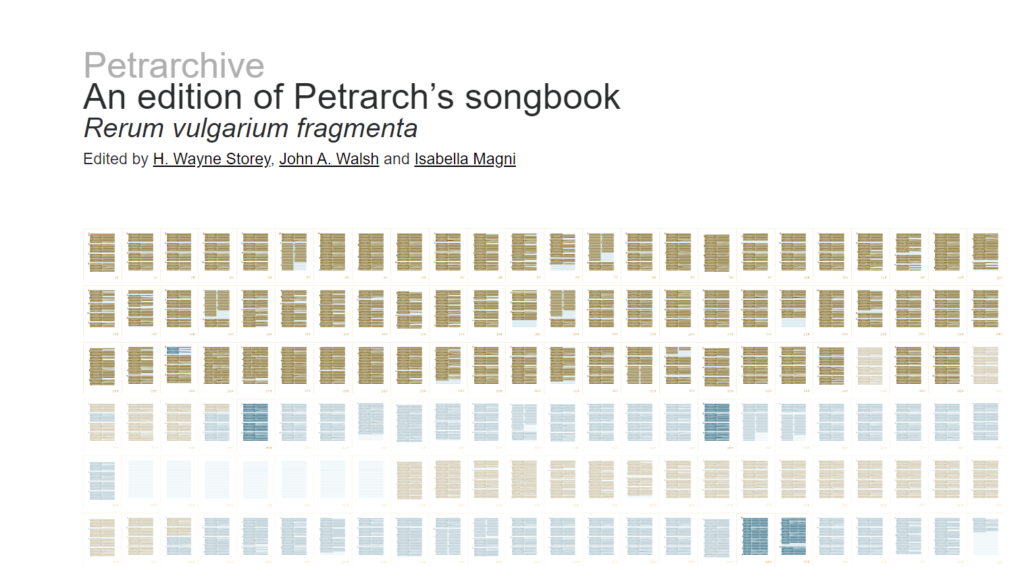
The Petrarchive (ed. Storey, Walsh and Magni) is an open access rich-text digital edition of Petrarch’s songbook Rerum vulgarium fragmenta (Rvf). The website does not reproduce in OCR other editions but proposes a new digital way of visualizing, studying and teaching Petrarch’s work by offering different levels of visualization of the texts (facsimile high-quality images of all the chartae of the partial holograph Vaticano Latino 3195, its complete diplomatic transcriptions and edited forms, a prototype for a new eleven-section commentary including a new English translation), as well as multiple indices and tools to access the diverse strata of the work’s composition.
The Petrarchive is designed as a tool both to introduce Petrarch’s collection—a collection that continues to influence modern cultures in many languages—and to give advanced users access to Petrarch’s “original” text and an extensive “material” commentary for each poem. Among the most innovative aspects of the project is its visual indexes. The project proposes, in fact, different ways of accessing Petrarch’s 366 poems, among which: 1) Text indices arranged and searchable by: a) poem number (in the physical order of Petrarch’s last version); b) alphabetical order of the poems (including retrievable palimpsests); c) genres (sonnets, sestinas, canzoni, ballate and madrigals); d) line graph of each charta. 2) A visual index of the external order and internal arrangement in line graph form of each charta 3) A visual index of the chartae arranged by the fascicle structure of Vatican Latino 3195
https://www.academia.edu/7820421/Early_Modern_Italy_1550-1790_A_Comprehensive_Bibliography_of_titles_in_English_and_French_12th_edition_2016
This ongoing work was conceived as an adjunct to the textbook The Origins of Early Modern Italy, 1550–1800 in order to place at the disposal of students and scholars the complete span of scholarship on Italy published in English and French. The material encompasses all aspects of political, social, economic, and cultural life in the broader Italy, including Corsica and Malta, and the mutual influence of Italy and other European countries. It contains an introduction and historiographical overview, supported by a statistical breakdown of types of studies over the last 150 years.
https://proquest.libguides.com/eebpqp
Printed sources from pre-1700 digitized from the major libraries of Europe for scholarly research.

A website of love emblems, a very popular genre based on word and image combinations for the youth in the Low Countries ca. 1600. It currently includes 27 Dutch love emblem books, religious as well as profane. For all of these we have full transcriptions, page facsimiles and indexes, as well as extended search options. Links to sources and parallels, translations and annotation are being added.

The Drawings of the Florentine Painters, a robust digital resource based on Berenson’s publication of the same name, allows users to search for nearly 4000 drawings by artist, title (i.e. subject, in English or Italian), location, and technique. Each entry includes key information from all three editions of Berenson’s text (1903, 1938 in English; 1961, in Italian), as well as the current location, an image of the catalog page, and plates included in 1903; most entries also have links to museum webpages, including images.

A digital restoration of the Lienzo de Quauhquechollan, an important 16th-c Guatemalan text depicting the Spanish conquest. The site provides historical context, annotation of the text, and a glossary of images.
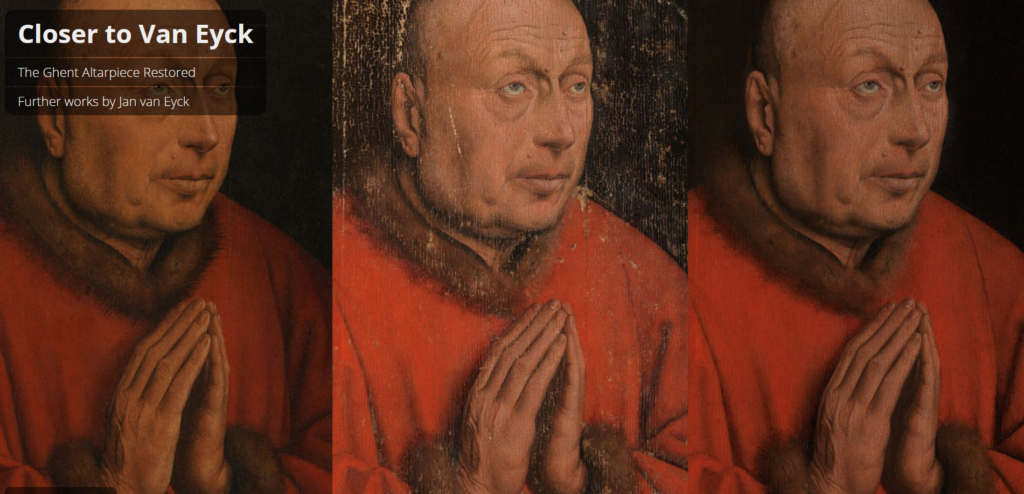
Closer to Van Eyck reconstructs the world of Hubert and Jan van Eyck, and to that of the art restorers who have painstakingly revealed the earlier glory of these paintings, which had been hidden for many centuries. Includes an index of images and videos of the restoration and photographic reconstruction d serves as a gateway for viewing the many high-resolution images of the Ghent Altarpiece. This web application provides information on the current restoration of the Ghent Altarpiece, and it allows you to study the polyptych.